Latest Articles
- Some Garter Snake Feeding Problems
- There are many reasons why captive snakes won’t eat in captivity. Garter snakes have a few more. (January 25, 2010)
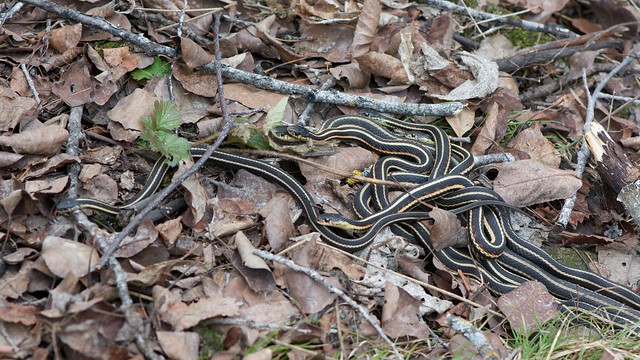
- Garter Snakes in Spring
- Photographers capture images of garter snakes emerging from hibernation. (April 26, 2009)
- Garter Snakes in Winter
- In winter, garter snakes are supposed to be hibernating. This presents some challenges when one turns up in your basement, or when you’re keeping them as pets over the winter. (January 7, 2008)
Recent Entries
Merced to Create Giant Garter Snake Habitat, Snakes Hopefully Will Arrive LaterFebruary 4, 2010
The city of Merced, California is paying nearly $400,000 to create habitat for the endangered Giant Garter Snake in a location where that species is not currently found, the Merced Sun-Star reports. The purchase and creation of the habitat is meant to offset the expansion of a wastewater treatment plant in an area identified as garter snake habitat. The company building the land bank says that the snakes will come once it’s built.
Three New Mexican Garter Snake Species Described in 2005January 31, 2010
Three additional species of garter snake were identified in a 2005 research paper. In their paper, “Species limits within the Mexican garter snakes of the Thamnophis godmani complex,” published in no. 79 of the Occasional Papers of the Museum of Natural Science and available as a PDF online, Douglas Rossman and Frank Burbrink argue that four populations of garter snake in central Mexico previously identified as Godman’s Garter Snake, Thamnophis godmani, are in fact four distinct species. This conclusion is based on the fact that the four populations are apparently isolated and morphologically distinct from one another. New, then, are Thamnophis bogerti and lineri, from the Mexican state of Oaxaca, and Thamnophis conanti, from the Puebla-Veracruz border. Entries in the Species Guide for these three species are forthcoming. Thanks to Stefan Allen for the tip.
Some Garter Snake Feeding ProblemsJanuary 25, 2010
When you keep a corn snake, kingsnake, or most other pet snakes, feeding is pretty straightforward. They eat rodents, and almost all of them will accept rodents that have been kept in the freezer and thawed. But even the easiest species of snake can present feeding problems. Baby snakes in particular may take forever to start eating. The mouse may have to be washed, or brained, or wiggled in front of the snake’s nose before the snake will eat it. There are a number of well-known tricks of the trade to get a recalcitrant snake to eat, and you can find them in the better pet manuals.
All of this also applies to garter snakes, but, as usual, garter snakes are a little bit different, and can present a few additional challenges — especially if they haven’t gotten accustomed to eating rodents.1 Here are a few feeding challenges I’ve noticed with my own garter snakes.
Read the rest of this article →
A New Plan for Sharp Park Golf Course and the San Francisco GarterNovember 6, 2009
San Francisco’s Recreation and Parks Department has proposed a “Solomonic” solution to the fate of Sharp Park Golf Course, owned by the City of San Francisco but contained within nearby Pacifica and habitat for the San Francisco Garter Snake. Environmentalists wanted the golf course restored to its natural state; the Department recommends keeping the course open, but with some modifications to accomodate the snake.
The Best Garter Snake Photos of the YearOctober 30, 2009
Recently, I put together a gallery of photos on Flickr that represented, I thought, some of the best in garter snake photography from the past year. There are 16 photos (so far; I have room for two more), taken from March to October, covering the continent from New England and Quebec to the Pacific Coast. Common Garter Snakes (Thamnophis sirtalis) make the most appearances, but there are a few Western Terrestrial Garter Snakes (T. elegans) and one photo of Two-striped Garter Snakes (T. hammondii). They’ve been caught emerging from hibernation, eating, and engaging in courtship. Some of the photos you will remember from this article. And lest you think all of these photos were taken by pros with expensive gear, many of these awesome shots were taken with consumer-grade cameras. Enjoy!
Garter Snakes Invade Seniors’ Home in ManitobaSeptember 18, 2009
Residents of a seniors complex are complaining about an invasion of garter snakes, which are turning up all over the place in their apartments. The trouble is, the apartment complex is in Inwood, Manitoba. This is a town that has a statue dedicated to the Red-sided Garter Snake (right); it’s only a few kilometres south of the famous Narcisse Snake Dens, and, if my visit there three years ago is any indication, is not exactly short of garter snakes itself. They are, in other words, an acknowledged tourist attraction; I’m surprised the residents didn’t get the memo. CBC News, Globe and Mail, Winnipeg Free Press, Winnipeg Sun.
Update: The province will repair cracks in the building’s foundation, starting next week.
Q&A: Feeding a Ribbon Snake in the BackyardAugust 30, 2009
Earlier this month, Daryl Frese wrote to me with an interesting story about a snake that kept coming for a visit.
We live near San Antonio, Texas. We have water gardens and fish ponds and have had garter snakes for the last few years that would show up at feeding time for the fish. We have always had fun watching them eat and learning their different personalities. This year, we have one that seemed a little bit more comfortable binging around us. After a few weeks of it coming closer and closer to us, my wife decided to put some food in her hand and see what would happen, and sure enough it came up and took the food out of her hand.
Is it OK to keep feeding her this way? We have started digging up earthworms and letting her (him) have a treat. She shows up about every three days, comes over to my wife and begs for dinner.
I wrote back to say that I couldn’t see any harm in it. While conventional wisdom is that feeding wild animals is a bad idea, I suspect that’s because there are real dangers for both animal and people alike when certain species get acclimated. An animal that becomes used to human contact can be dangerous if it’s a predator, but more generally is less able to fend for itself. I don’t think a wild snake’s ability to survive is going to be impeded by being hand-fed by humans every now and then.
Read the rest of this article →
Three Evolutionary Routes to Newt Toxin ImmunityAugust 20, 2009
Three different garter snake species took different evolutionary paths to arrive at immunity to newt toxins, a new study published in the Proceedings of the National Academy of Science has found. The species in question are the Pacific Coast Aquatic Garter Snake (Thamnophis atratus), the Sierra Garter Snake (T. couchii) and the Common Garter Snake (T. sirtalis), all of which can swallow enough tetrodotoxin to kill a human being several times over when they eat a newt from the genus Taricha.
Previously: Garter Snakes Win Arms Race with Newts.
Giant Garter Snake Population RediscoveredAugust 7, 2009
A biologist’s study of the 13 historic subpopulations of Giant Garter Snake (Thamnophis gigas) to see how many still exist has turned up a population of them in a wetland north of Stockton, California. It’s the first time in 15 years that they’ve been spotted in San Joaquin County, the Stockton Record reports. Eric C. Hansen’s research also confirms that 11 of the 13 historic subpopulations are still going concerns: good news for the threatened reptile.
Q&A: Feeding Recently Wild-Caught Garter SnakesApril 30, 2009
Liz writes with a question about feeding two recently caught garter snakes:
I recently found two small garter snakes while hiking in a nearby forest. My fiancé and I decided to catch them and take them home. I read through your articles on caring for garter snakes and it has helped a lot helping me meet the needs of my snakes, although I am having trouble finding food that they will eat.
Before I read your article my fiancé swore they ate crickets though I know now that is not true.
I also tried small goldfish (alive in a rock bowl) but there was no reaction to them. One of the snakes poked its head in the water and went right past the fish. One of the fish died so I cut it up right away and tried to serve it to them that way and still nothing.
Someone also said they do not eat very often so I thought that may be why I couldn’t get them to eat anything.
I have not yet tried earthworms; the pet store was out of them when I tried to pick some up and pinkies are so expensive I was afraid I would spend money on them and they would be ignored as well.
I’m a little concerned that my snakes will die if I don’t find something they will eat soon. I have had them for about three and a half days now, and as far as I could tell they have not had anything to eat.
The pet stores in my area have been having problems with getting their shipments of fish in so no one has guppies and one place had minnows but refused to sell them when they heard it was for snake food.
I am all out of ideas other than drowning my lawn for worms.
Catching wild snakes involves a host of considerations that buyers of captive-bred snakes don’t usually have to face; the biggest of these is getting a recently caught snake to feed. (This is one big reason why most snake keepers recommend getting captive-bred animals wherever possible, incidentally.)